

- 日期:2026-08-27
- 分類:工業&工程
What Are Polycarbonate Roof Screws?
Polycarbonate roof screws are fasteners used to secure polycarbonate roofing sheets to timber, steel, aluminum, or other roof framing systems. Although they may look similar to ordinary roofing screws, the fastening system used for polycarbonate must account for one important characteristic: polycarbonate expands and contracts as temperature changes.
Because of this movement, simply driving a standard screw tightly through a sheet can create stress around the hole. Over time, that stress can contribute to cracking, distortion, enlarged holes, or water leakage. A suitable polycarbonate fastening system normally includes a corrosion-resistant screw together with a sealing washer, dome washer, spacer, or purpose-designed fixing component.
These screws are commonly used for corrugated and profiled polycarbonate roofing on patios, pergolas, carports, awnings, walkways, agricultural structures, greenhouses, garden shelters, and light commercial roofing. The exact screw style depends on the sheet profile, framing material, climate, roof pitch, and manufacturer instructions.
Why Do Polycarbonate Roof Screws Matter?
The screws used on a polycarbonate roof do more than keep the sheet attached to the structure. They affect water resistance, wind resistance, sheet movement, roof noise, visual appearance, and long-term service life. A poor fastening method can reduce the performance of an otherwise high-quality roofing sheet.
1. They Help Prevent Water Leaks
A roofing screw normally works with a sealing washer to close the penetration through the sheet. If the washer is missing, damaged, incorrectly positioned, or compressed too far, rainwater may enter around the screw hole. This is one of the most common reasons a roof begins leaking around individual fasteners.
2. They Allow for Thermal Expansion
Polycarbonate changes dimensions as temperature changes. On a warm sunny roof, the sheet can become significantly hotter than the surrounding air. A fastening system that does not allow sufficient movement can place concentrated stress around screw holes. This is why installers often use oversized or pre-drilled holes according to the sheet manufacturer's instructions.
3. They Reduce the Risk of Cracking
Driving a fastener directly into polycarbonate without appropriate clearance can cause cracks to begin around the penetration. Over-tightening can create the same problem. A correctly installed roof screw should secure the panel without distorting or crushing the sheet.
4. They Help the Roof Resist Wind Loads
Fastener spacing and edge fastening are important because wind pressure and uplift can act strongly on lightweight roofing materials. Using too few screws may allow panels to flex excessively or lift around edges. However, simply adding more screws is not always better; the correct fixing pattern should match the sheet profile and structural design.
5. They Improve Long-Term Roof Stability
Proper polycarbonate roof screws help panels stay aligned over time. If fasteners loosen, corrode, or allow excessive panel movement, the roof may develop rattling, lifted edges, misaligned overlaps, or localized leakage. Choosing compatible fasteners at the beginning reduces the need for premature repair work.
Which Polycarbonate Roof Screw Type Should You Choose?
The best fastener depends largely on the roof frame. A timber structure and a steel structure require different screw threads and drilling characteristics. The goal is to create a secure connection to the frame while protecting the polycarbonate around the fixing point.
Screws for Timber Frames
For timber purlins or rafters, roofing screws generally use a thread designed to bite securely into wood. The screw must be long enough to pass through the roofing profile, washer system, and any spacer before achieving adequate embedment in the timber.
Self-Drilling Screws for Metal Frames
Steel or aluminum framing often uses self-drilling roofing screws. These fasteners are designed to drill into metal without a separate pilot hole in the frame. However, that does not mean the polycarbonate sheet itself should necessarily be drilled directly by the same screw without preparation. The sheet may still require a clearance hole first.
Screws with EPDM or Sealing Washers
Roofing screws commonly use weather-resistant rubber sealing washers, often paired with metal backing washers. Their job is to distribute pressure and help seal the screw penetration. The washer should sit flat against the roofing surface without being crushed excessively.
Purpose-Designed Polycarbonate Fixing Buttons
Some roofing systems use larger fixing buttons, domed washers, or proprietary fastener assemblies. These spread the load across a broader area and may provide additional clearance around the screw. For certain sheet profiles, these components can be preferable to ordinary small roofing washers.
How to Install Polycarbonate Roof Screws in 5 Steps
Correct installation matters just as much as choosing the correct screw. The following five-step process provides a practical overview, but the roofing sheet manufacturer's fixing guide should always take priority when specific spacing, drilling, or fixing instructions are provided.
Step 1: Confirm the Framing and Sheet Layout
Before drilling, confirm that the purlins or rafters are correctly spaced and that the roofing sheets are positioned squarely. Check the sheet orientation, overlap direction, roof pitch, and required overhang. Poor alignment at this stage cannot be corrected simply by adding more screws later.
Step 2: Mark the Fastener Positions
Mark fixing points according to the roofing profile and manufacturer recommendations. Edge zones, corners, and exposed locations may require different fastening patterns from central roof areas. Avoid placing screws too close to sheet edges unless specifically required by the system.
Step 3: Pre-Drill the Polycarbonate Sheet
Use a clean, sharp drill bit and create holes large enough to accommodate expected thermal movement. The exact clearance depends on the sheet type, sheet length, climate, and manufacturer specification. The hole should be clean and free of large burrs or cracks.
Step 4: Install the Screw and Washer
Position the screw through the washer or fixing button and drive it into the supporting frame. Keep the fastener perpendicular where possible so the washer seals evenly. If it enters at an angle, one side of the washer may compress more than the other and create an unreliable seal.
Step 5: Stop Before Over-Tightening
Tighten the screw only enough to hold the sheet and seat the washer. Do not keep driving until the sheet visibly dimples or the rubber washer squeezes far beyond the metal washer. Over-tightening restricts movement and can damage both the washer and the polycarbonate.
Polycarbonate Roof Screw Selection Table
| Roofing Situation | Typical Fastener Choice | Washer / Accessory | Main Point to Check |
|---|---|---|---|
| Timber pergola | Roofing screw designed for timber | Weather-resistant sealing washer | Adequate timber embedment |
| Steel carport | Self-drilling metal roofing screw | EPDM-style sealing washer | Correct drill point for steel thickness |
| Corrugated polycarbonate | Profile-compatible roof screw | Large washer or fixing button where specified | Fixing location on the sheet profile |
| Greenhouse roofing | Corrosion-resistant compatible fastener | Sealing washer or proprietary fixing | Thermal movement and moisture exposure |
| Coastal or humid area | Higher corrosion-resistance fastener | UV- and weather-resistant washer | Material compatibility and corrosion resistance |
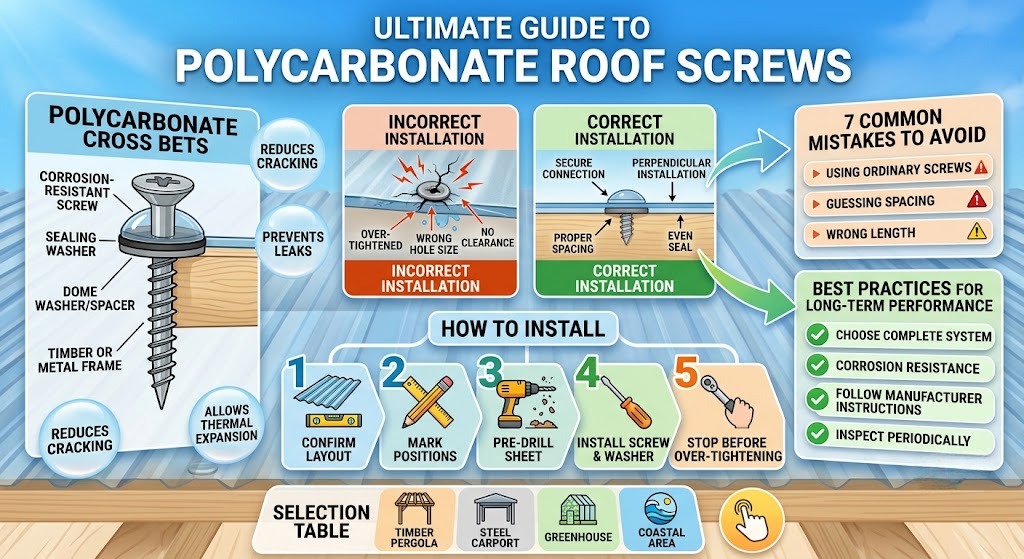
7 Common Polycarbonate Roof Screw Mistakes
1. Using Ordinary Screws Without Proper Washers
An ordinary screw head provides very little sealing area and can concentrate stress at the hole. A roofing-compatible screw and washer system is generally a better choice for exposed polycarbonate roofing.
2. Driving Screws Directly Through the Sheet Without Clearance
Polycarbonate needs room to move. If the screw tightly fills the hole, expansion may push against the fastener and create stress cracks. Pre-drilling helps reduce this risk when required by the roofing system.
3. Over-Tightening the Screws
This is one of the easiest mistakes to make with a cordless impact driver. A screw that is too tight may crush the washer, distort the panel, or prevent movement. Use controlled torque and stop as soon as the washer is correctly seated.
4. Using the Wrong Screw for the Frame Material
A timber screw is not automatically suitable for steel framing, and a metal self-drilling screw is not automatically ideal for timber. The thread and drill point must match the substrate.
5. Choosing the Wrong Screw Length
A fastener that is too short may not achieve adequate engagement in the structural frame. A screw that is unnecessarily long may be difficult to install cleanly or may interfere with components beneath the roof. Select the length based on sheet profile, washer thickness, spacers, and framing depth.
6. Ignoring Corrosion Resistance
Outdoor screws are exposed to moisture, condensation, pollution, and sometimes salt-laden air. If the fastener coating is not suitable for the environment, corrosion can stain the roof, weaken the fastener, and damage the sealing washer.
7. Guessing the Screw Spacing
There is no single screw spacing that is correct for every polycarbonate roof. Fastener frequency depends on panel profile, support spacing, wind exposure, roof edge zones, and manufacturer specifications. Guessing the pattern can lead to either insufficient restraint or unnecessary penetrations.
Best Practices for Long-Term Roof Performance
Choose Fasteners as a Complete System
Do not evaluate the screw alone. Consider the screw, washer, fixing button, spacer, sheet profile, frame material, and installation method together. A fastener that works well in one roofing system may not be appropriate in another.
Use Corrosion-Resistant Components
Choose fasteners suitable for the environmental exposure. Coastal buildings, greenhouses, industrial areas, and consistently wet climates can place greater demands on fastener coatings and washer materials than protected residential locations.
Follow the Sheet Manufacturer's Fixing Instructions
Polycarbonate profiles vary in thickness, geometry, support requirements, lap arrangement, and expansion allowance. Manufacturer documentation usually specifies important details such as support spacing, drilling allowances, fastener locations, and compatible accessories.
Inspect Fasteners Periodically
After installation, periodically check for loose screws, cracked washers, corrosion, enlarged holes, or panel movement. Early maintenance is usually easier and less expensive than dealing with widespread leakage or damaged sheets later.
Conclusion and Next Steps
Choosing the right polycarbonate roof screws is a small part of a roofing project, but it has a major influence on the final result. The correct fastener should suit the frame material, resist outdoor exposure, work with an effective sealing washer, and allow the polycarbonate sheet to expand and contract without unnecessary stress.
For a reliable installation, avoid ordinary screws, do not over-tighten fasteners, and do not assume one spacing pattern works for every roof. Confirm the recommended hole size, screw position, fastener spacing, washer type, and frame compatibility before installation begins.
Next step: Before ordering polycarbonate roof screws, prepare the sheet profile, sheet thickness, frame material, frame thickness, roof dimensions, exposure conditions, and manufacturer fixing requirements. This information makes it much easier to select a suitable screw and washer system.
Polycarbonate Roof Screws FAQ
Q1: What screws should I use for polycarbonate roofing?
Use roofing screws that match the supporting frame, such as timber roofing screws for wood or suitable self-drilling screws for metal. The screw should normally be paired with a weather-resistant sealing washer or a purpose-designed polycarbonate fixing component.
Q2: Should I pre-drill holes for polycarbonate roof screws?
In many polycarbonate roofing systems, pre-drilling is recommended so the hole provides enough clearance for thermal expansion. The exact hole size depends on the sheet system, panel length, temperature range, and manufacturer instructions.
Q3: Can I use normal roofing screws on polycarbonate sheets?
Some roofing screws may be compatible, but the complete fastening method must suit polycarbonate. The screw, washer, fixing location, hole clearance, and tightening pressure all matter. A standard screw used incorrectly can crack the panel or cause leaks.
Q4: How tight should polycarbonate roof screws be?
The screw should be tight enough to seat the washer and secure the sheet, but not so tight that the polycarbonate dimples or the washer becomes heavily crushed. Excessive torque may restrict thermal movement and contribute to cracking.
Q5: How far apart should polycarbonate roof screws be?
There is no universal spacing. Fastener spacing depends on the sheet profile, support spacing, wind exposure, roof edge zones, and roofing manufacturer requirements. Always use the fixing schedule recommended for the specific roofing product.
Q6: Do polycarbonate roof screws need rubber washers?
A weather-resistant sealing washer or purpose-designed fixing is commonly used because it helps seal the penetration and spread pressure around the screw. The exact washer type should match the roofing system and outdoor exposure conditions.
Q7: Why do polycarbonate sheets crack around screws?
Cracking can occur when holes are too tight, screws are over-tightened, the wrong washer is used, fasteners are positioned poorly, or the sheet cannot expand and contract freely. Impact damage and improper drilling can also contribute.
Q8: Can self-drilling screws be used on polycarbonate roofing?
Self-drilling screws are commonly used when the roof is fixed to metal framing. However, the polycarbonate sheet may still need a separate clearance hole, so the manufacturer's installation instructions should be followed rather than drilling blindly through the sheet.
Q9: What screw material is best for outdoor polycarbonate roofs?
Choose a fastener with corrosion resistance suitable for the installation environment. The best option depends on moisture, pollution, coastal salt exposure, frame material, and compatibility with surrounding components.
Q10: How can I stop polycarbonate roof screws from leaking?
Use compatible screws and sealing washers, drill correctly sized holes, keep screws perpendicular, avoid over-tightening, and inspect washers periodically. Leaks often begin when washers degrade, screws loosen, or holes become stressed or enlarged.
社交媒體