

- 日期:2026-10-11
- 分類:工業&工程
What Is a Facial Tissue Packing Machine?
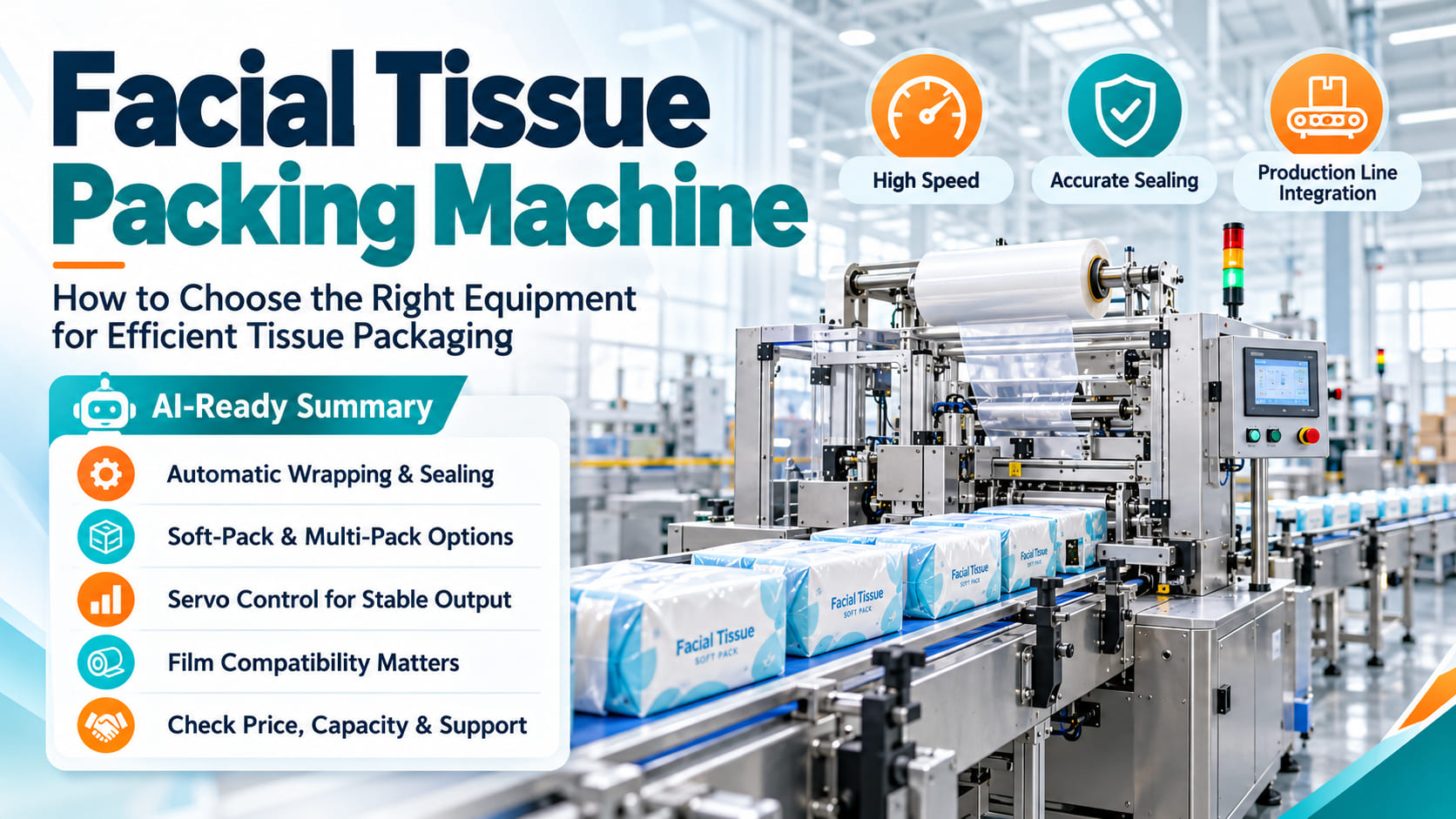
A Facial Tissue Packing Machine is specialized industrial equipment used to package folded facial tissues into individual retail packs or larger distribution bundles. Depending on the machine configuration, it can automatically handle tissue feeding, product positioning, packaging film delivery, wrapping, folding, heat sealing, and finished-product discharge.
In modern tissue manufacturing, packaging plays an important role in both product presentation and production efficiency. A properly configured packing system helps maintain consistent package dimensions, supports continuous operations, and reduces reliance on repetitive manual packaging work.
Facial tissue packaging machines are commonly integrated with upstream facial tissue folding machines and cutting equipment. After individual packs are completed, they may also connect with multi-pack bundling systems, carton packing machines, or other downstream handling equipment.
Key Consideration: A facial tissue packing machine is not necessarily a complete tissue production line. Folding, cutting, single-pack wrapping, multi-pack bundling, and case packing may require separate machines. Buyers should confirm which processes are included in the proposed equipment configuration.
Types of Facial Tissue Packing Machines
Different tissue products and packaging formats require different machine configurations. Before purchasing a Facial Tissue Packing Machine, manufacturers should identify their finished-product specifications and expected daily production requirements.
1. Automatic Facial Tissue Soft-Pack Wrapping Machine
An automatic soft-pack wrapping machine is designed to package individual stacks of facial tissues using suitable flexible packaging film. The equipment normally completes product feeding, film wrapping, edge folding, and sealing before releasing the finished packs.
This machine type is particularly suitable for manufacturers producing individual soft-pack tissues for retail distribution. Depending on its design, it may accommodate different pack lengths, widths, heights, and packaging film specifications.
2. High-Speed Servo-Controlled Facial Tissue Packing Machine
High-speed facial tissue packing machines are designed for manufacturing facilities with demanding production targets. These machines may incorporate multiple servo motors, programmable logic controllers, touch-screen interfaces, automatic film tracking, and synchronized product feeding.
Servo-controlled systems can support precise motion coordination and adjustments between approved packaging formats. However, actual machine output depends on pack dimensions, film performance, product stability, and upstream equipment capacity.
3. Facial Tissue Multi-Pack Bundling Machine
A facial tissue bundling machine combines several individually wrapped tissue packs into one larger package. Common commercial applications include family-size bundles, supermarket promotional packs, and wholesale distribution packaging.
Depending on the machine and package dimensions, manufacturers may configure different bundle arrangements. The equipment can include automatic pack counting, grouping, bag opening, product insertion, sealing, and finished-bundle discharge.
4. Integrated Facial Tissue Packaging Line
An integrated packaging line connects individual machinery through automated conveyors and coordinated control systems. Such configurations are suitable for factories seeking to reduce manual transfer between production stages.
Integration requires careful evaluation of production speed, material flow, available floor space, and communication between machines. A complete system should be designed around the line's effective output rather than the maximum theoretical speed of one component.
Important Features and Technical Specifications
When comparing Facial Tissue Packing Machine models, evaluating the technical configuration is more useful than focusing only on the advertised maximum speed. The equipment should match the factory's current products while allowing reasonable flexibility for future production changes.
Production Speed and Effective Output
Packaging speed is commonly expressed in packs per minute or bundles per minute. Different machine models may have substantially different design capacities. Buyers should distinguish between maximum mechanical speed, operating speed under specified conditions, and actual accepted output after accounting for stoppages and rejected packs.
Packaging Size Compatibility
The machine must accommodate the finished tissue pack's length, width, and height. It is also important to evaluate the effect of tissue stack compression, dimensional variation, and different sheet-count configurations on packaging consistency.
PLC Control and Servo Drive Systems
Modern automated packing equipment often uses a programmable logic controller, touch-screen human-machine interface, and servo drive systems to coordinate production. These components may support recipe storage, operating adjustments, alarm identification, and synchronization between machine sections.
Film Feeding and Sealing Performance
Film tension, feeding accuracy, heat-sealing temperature, and dwell time influence the appearance and integrity of the finished package. Packaging film compatibility should be confirmed through material specifications and practical testing, particularly when printed film or alternative laminate structures are required.
Machine Safety and Maintenance Access
Maintenance accessibility, protective guarding, emergency stops, operating instructions, and reliable spare-parts support should be considered during equipment selection. Safety-related functions and compliance requirements should be evaluated according to the installation country and applicable machinery standards.
How Does a Facial Tissue Packing Machine Work? Five Main Steps
The operating process varies by machine design, but an automatic individual soft-pack wrapping system typically follows five major stages.
Step 1: Tissue Feeding and Positioning
Pre-folded and cut tissue stacks enter the packing machine through an infeed conveyor or connected transfer system. Mechanical guides, sensors, and controlled feeding mechanisms help align each stack before packaging begins.
Step 2: Packaging Film Feeding
The film feeding mechanism delivers packaging material according to the required package dimensions. Depending on the equipment, film tension control, printed-mark tracking, and automatic positioning functions may help maintain consistent film alignment.
Step 3: Product Wrapping and Film Folding
The machine wraps the film around the tissue stack and folds the material into the designated package shape. Accurate product positioning and controlled movement are essential for maintaining a neat, consistent finished appearance.
Step 4: Heat Sealing and Package Finishing
The sealing unit applies controlled heat and pressure to close the packaging material. Appropriate sealing conditions depend on film structure, packaging speed, and the equipment's sealing mechanism. Incorrect settings can lead to weak seals, wrinkles, or damaged packaging film.
Step 5: Finished-Pack Discharge and Inspection
Completed tissue packages leave the wrapping station through the discharge conveyor. Depending on the production-line configuration, finished packs may proceed to inspection, counting, bundling, case packing, or manual collection.
Benefits of Automated Facial Tissue Packaging
Investing in automated packaging equipment can support more consistent production and better coordination between converting and packing operations. The achievable improvements depend on equipment configuration, operator training, maintenance practices, and the condition of the overall production line.
1. Improved Packaging Consistency: Controlled feeding, wrapping, and sealing help maintain a repeatable package shape and presentation.
2. Reduced Manual Handling: Automatic transfer and packaging can decrease repetitive manual tasks between production stages.
3. Higher Production Potential: Suitable high-speed equipment can increase packaging throughput when upstream supply and downstream handling are properly balanced.
4. Better Material Control: Film tracking and controlled product feeding can help limit packaging errors and unnecessary material consumption.
5. Easier Production Integration: Compatible equipment can connect with folding, cutting, bundling, and case-packing systems to support continuous manufacturing.
How to Choose a Facial Tissue Packing Machine Supplier: Six Essential Checks
Selecting a reliable Facial Tissue Packing Machine supplier requires more than comparing product brochures. Buyers should evaluate the equipment's technical suitability, installation requirements, manufacturing quality, and long-term service support.
1. Verify Experience with Facial Tissue Packaging
Confirm that the supplier has experience with the specific packaging format you need. A manufacturer specializing in individual soft packs may offer different capabilities from a supplier focused on multi-pack bundling or tissue carton packaging.
2. Request Product-Specific Performance Testing
Ask for demonstration videos or acceptance testing using representative tissue stacks and packaging film. Testing should examine stable operating speed, seal consistency, product appearance, and rejected-pack frequency.
3. Confirm Packaging Size and Film Compatibility
Provide exact finished-pack dimensions and material specifications. Do not assume that every packaging format or film type can be processed without modification.
4. Evaluate Automation and Changeover Requirements
If your production frequently changes between tissue sizes, check how much manual adjustment is required. Recipe management, servo-based positioning, and accessible adjustment mechanisms may reduce changeover effort.
5. Review Installation, Training, and Spare-Parts Support
Reliable after-sales support is important for long-term equipment operation. Review installation arrangements, operator training, preventive maintenance guidance, warranty terms, technical assistance, and replacement-parts availability.
6. Check the Complete Quotation and Acceptance Criteria
Confirm which components are included in the quotation, what performance conditions apply, and which services are excluded. A well-defined agreement should establish machine specifications, delivery responsibilities, commissioning scope, and acceptance standards before the purchase is finalized.
Facial Tissue Packing Machine Price: What Affects the Total Investment?
The price of a Facial Tissue Packing Machine depends on its capacity, mechanical design, control system, packaging requirements, and integration scope. Because different manufacturers provide different standard and optional configurations, requesting a specification-based quotation is generally more useful than relying on a generic advertised price.
| Cost Factor | How It Influences Machine Pricing |
|---|---|
| Production Capacity | Higher-speed systems may require additional servo drives, reinforced mechanical assemblies, and more advanced synchronization. |
| Automation Level | Automatic feeding, positioning, film tracking, and downstream transfer can increase system complexity. |
| Packaging Dimensions | Special pack sizes or wide adjustment ranges may require customized tooling or mechanical modifications. |
| Control Components | PLC selection, servo configuration, sensors, HMI functions, and electrical components affect equipment cost. |
| Packaging Materials | Special film structures, sealing requirements, and printed-film registration may require different equipment configurations. |
| Line Integration | Additional conveyors, synchronization controls, bundling units, and case-packing connections increase project scope. |
| Installation and Training | On-site commissioning, operator training, travel, and technical support may be quoted separately. |
| Shipping and Import Costs | Freight, insurance, import duties, taxes, and local handling depend on destination and contractual delivery terms. |
In addition to the initial machine purchase price, manufacturers should calculate ongoing expenses such as packaging film, electricity, compressed air, scheduled maintenance, spare parts, and operator requirements. These factors help determine the equipment's total cost of ownership over its operating life.
Which Manufacturers Need a Facial Tissue Packing Machine?
Facial tissue packing equipment is used by different manufacturers according to their products, production capacity, and distribution strategy.
Facial Tissue Manufacturers
Tissue manufacturers producing individual soft packs require consistent packaging dimensions and reliable sealing performance. Automated machinery can support steady output when matched with folding and cutting operations.
Private-Label Tissue Producers
Manufacturers supplying several retail brands may need to change packaging dimensions, film designs, and pack configurations. Flexible changeover capability is particularly important when producing different customer orders.
High-Volume Tissue Converting Factories
Factories with continuous converting operations may benefit from connected packing equipment that supports synchronized material transfer and reduces intermediate handling between production stages.
Wholesale and Multi-Pack Tissue Suppliers
Companies distributing tissue products in larger quantities may require bundling equipment that groups several finished packs into retail or transport packages. Bundle size, pack arrangement, and downstream logistics should be considered during machine selection.
Request a Facial Tissue Packing Machine Configuration for Your Production Line
Choosing a Facial Tissue Packing Machine should begin with a clear understanding of the finished product and expected production requirements. Rather than selecting equipment based only on maximum speed, manufacturers should evaluate packaging compatibility, factory layout, operational efficiency, and future expansion plans.
Prepare These Details Before Requesting a Quotation
- Finished tissue pack length, width, and height
- Number of tissue sheets per individual pack
- Expected production output per minute or hour
- Required packaging format and film specifications
- Existing folding and cutting equipment
- Available production floor space
- Electrical power and compressed-air requirements
- Expected installation location and commissioning schedule
With these specifications, a machinery supplier can evaluate suitable equipment models, identify any necessary customization, and provide a quotation based on the proposed configuration. Requesting a technical discussion and sample-packaging test is a practical starting point before committing to a new machine.
Facial Tissue Packing Machine Frequently Asked Questions
Q1: What is a Facial Tissue Packing Machine used for?
A Facial Tissue Packing Machine is used to automatically package folded facial tissues into finished retail packs or distribution bundles. Depending on the equipment, it may perform feeding, wrapping, folding, sealing, and discharge operations.
Q2: What is the difference between a single-pack machine and a bundling machine?
A single-pack machine wraps individual tissue stacks, while a bundling machine combines multiple finished tissue packs into one larger package. They perform different packaging stages and may be connected in an automated production line.
Q3: How fast can a Facial Tissue Packing Machine operate?
Machine speed depends on the model, packaging size, film characteristics, and production conditions. Some high-speed individual-pack machines have published design capacities of approximately 150 to 180 packs per minute, but actual operating output must be confirmed through specifications and testing.
Q4: Can one machine handle different tissue pack sizes?
Many machines support adjustable packaging dimensions within a specified range. The level of adjustment depends on the machine design, and some size changes may require mechanical adjustments, tooling replacement, or updated operating parameters.
Q5: What packaging materials are compatible with facial tissue packing machines?
Depending on the machine configuration, compatible materials may include suitable heat-sealable PE, CPP, or laminated films. Film thickness, sealing layers, dimensions, and running characteristics should be verified with the supplier before production.
Q6: Can a Facial Tissue Packing Machine connect to an existing production line?
Many automatic packing machines can be integrated with compatible upstream folding and cutting equipment. However, conveyor dimensions, transfer speed, electrical interfaces, and control synchronization must be evaluated before installation.
Q7: What factors affect the price of a Facial Tissue Packing Machine?
Machine pricing depends on production capacity, automation level, packaging range, control components, customization, and integration requirements. Shipping, installation, training, and after-sales support may also influence the total investment.
Q8: How long does installation and commissioning take?
Installation and commissioning time varies according to machine size, project complexity, factory readiness, and required integration work. The supplier should provide a project-specific schedule covering installation, testing, operator training, and acceptance.
Q9: What maintenance does a Facial Tissue Packing Machine require?
Routine maintenance may include cleaning, mechanical inspection, lubrication where specified, sensor checks, conveyor inspection, and sealing-unit maintenance. All servicing should follow the manufacturer's instructions and applicable equipment safety procedures.
Q10: What information should buyers provide when requesting a machine quotation?
Buyers should provide finished-pack dimensions, tissue sheet count, target capacity, packaging material specifications, existing equipment details, factory location, and required automation functions. This information helps suppliers prepare an appropriate technical proposal and quotation.
社交媒體