

- 日期:2026-10-10
- 分類:工業&工程
What Is a Heavy Duty Door?
A heavy duty door is designed for environments where a conventional commercial door may not provide enough durability, structural strength, impact resistance, or long-term reliability. These doors are commonly installed in factories, warehouses, logistics facilities, mechanical rooms, industrial buildings, service corridors, loading areas, utility spaces, and security-sensitive locations.
The term “heavy duty” does not refer to one single door design. Depending on the project, a heavy duty door may use reinforced steel sheets, stronger internal cores, heavier frames, high-cycle hinges, industrial-grade locks, reinforced closers, protective finishes, or specialized seals. The goal is to create a door system capable of handling repeated operation and demanding site conditions without premature deformation or hardware failure.
When choosing between a heavy duty door and a standard commercial door, buyers should therefore evaluate the complete opening rather than the door leaf alone. Frame construction, hinges, locks, closers, anchors, thresholds, seals, wall conditions, and installation quality all influence long-term performance.
Quick Decision: If a door is opened hundreds of times per day, exposed to carts or equipment, located in a harsh industrial environment, or expected to remain reliable under frequent use, a heavy duty door is usually worth considering.
Heavy Duty Door vs Standard Commercial Door: Key Differences
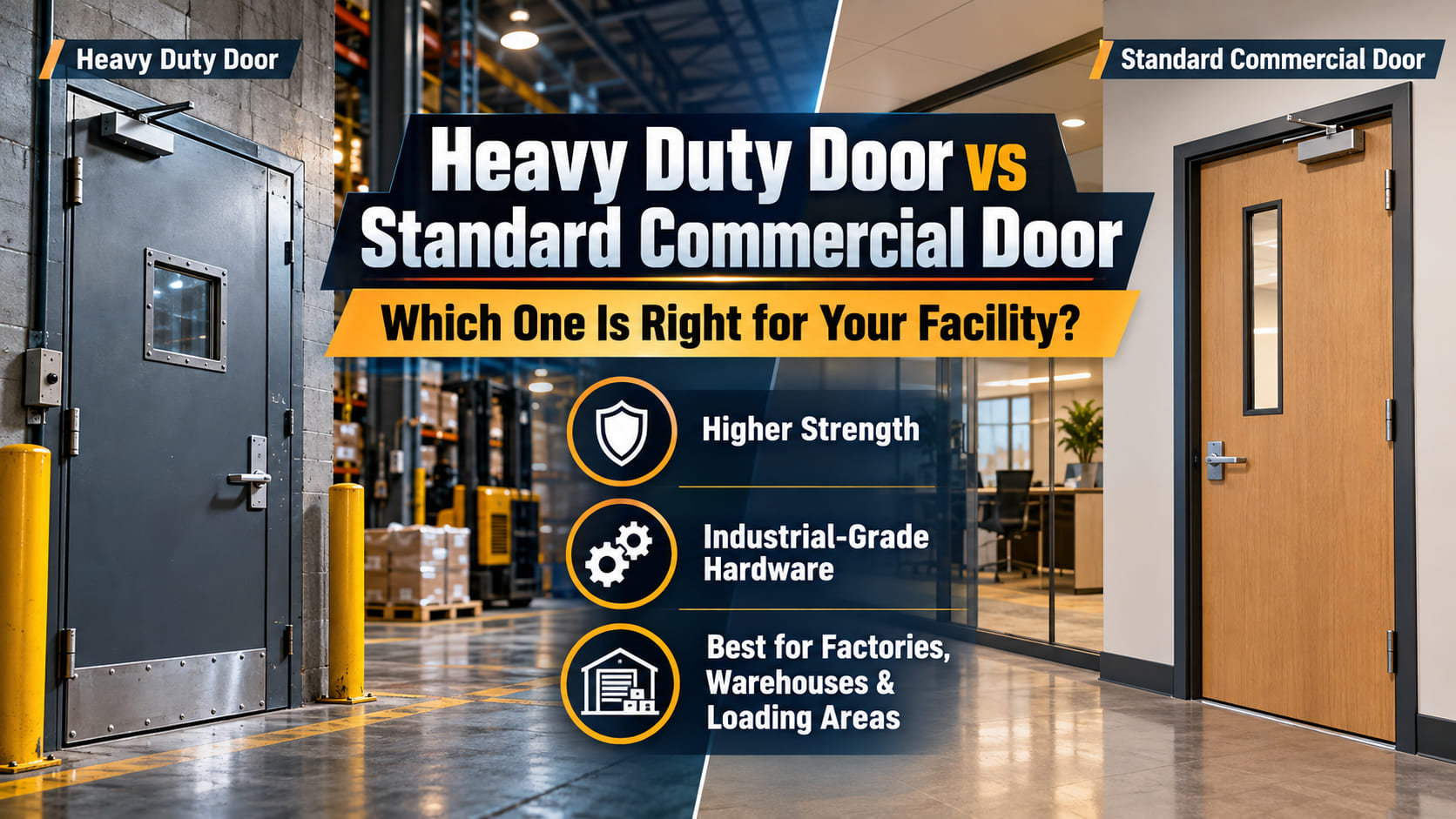
Both options can perform well when correctly matched to the application. The main difference is that a heavy duty door is generally engineered for higher operating demands, while a standard commercial door is intended for normal pedestrian use and moderate traffic.
| Item | Heavy Duty Door | Standard Commercial Door | Best For |
|---|---|---|---|
| Traffic Level | High-frequency or continuous operation | Low to moderate daily use | Industrial sites and busy service areas |
| Structural Strength | Higher resistance to repeated stress and impact | Suitable for normal commercial operation | Factories, warehouses, utility areas |
| Hardware | Industrial-grade hinges, locks and closers | Standard commercial hardware | High-cycle openings |
| Impact Resistance | Typically designed for more demanding conditions | Generally intended for pedestrian traffic | Areas with carts, equipment or material handling |
| Maintenance | May reduce replacement frequency when correctly specified | Lower initial complexity but may wear faster under heavy use | Facilities focused on lifecycle performance |
| Initial Cost | Usually higher | Usually lower | Budget-sensitive low-traffic projects may prefer standard doors |
| Lifecycle Value | Potentially better in demanding applications | Good value when heavy-duty performance is unnecessary | Depends on frequency of use and operating conditions |
| Typical Locations | Factory, warehouse, plant room, logistics area | Office, retail, corridor, meeting room | Choose according to traffic and risk |
The important point is not that a heavy duty door is automatically “better.” Overspecifying a door can unnecessarily increase project cost, while underspecifying one can lead to frequent repairs, misalignment, damaged hardware, or early replacement. The objective is to match the door system to the real operating environment.
What Makes a Heavy Duty Door Different?
1. Reinforced Door Construction
Heavy duty doors are typically designed with stronger construction than doors intended for light commercial use. Depending on the specification, this may involve thicker face sheets, reinforced edges, internal stiffeners, stronger cores, or additional reinforcement around locks and hinges. These features help the door maintain alignment under repeated use.
2. Stronger Frames and Anchoring
A durable door leaf cannot perform properly if the frame moves, twists, or pulls away from the wall. Heavy duty applications therefore require attention to frame gauge, reinforcement, anchoring, wall construction, grout requirements, and installation tolerances. The frame should be specified as part of the complete opening.
3. High-Cycle Hardware
Hinges, pivots, locks and door closers are common wear points. A heavy duty door installed with light-duty hardware may still fail prematurely. Facilities with frequent traffic should therefore evaluate expected operating cycles and choose hardware designed for the anticipated workload.
4. Environmental Resistance
Moisture, chemicals, heat, humidity, dust and outdoor exposure can influence door performance. Coating systems, galvanized materials, stainless components or other protective options may be appropriate depending on the operating environment. Material selection should be based on actual exposure rather than appearance alone.
5. Security and Access Requirements
In some facilities, heavy duty doors also form part of the building's access-control strategy. Reinforced lock areas, suitable hardware preparation, controlled entry systems and properly matched frames may all be relevant. If security is a major requirement, the complete opening should be evaluated as a system rather than relying on door thickness alone.
Three Buying Scenarios: Which Door Should You Choose?
Scenario 1: First-Time Buyer or General Commercial Project
If the opening is located in an office, administrative building, retail unit, meeting room, or low-traffic corridor, a standard commercial door may be sufficient. There is little value in paying for industrial-level reinforcement if the door will only experience moderate pedestrian use. Focus instead on reliable hardware, correct installation, suitable fire or acoustic requirements where applicable, and ease of maintenance.
Scenario 2: Budget-Controlled Project
If budget is the main concern, do not automatically select the lowest-priced door. First divide the project into high-use and low-use areas. Install heavy duty doors only where traffic, impact risk, or operating conditions justify the extra specification, while using standard commercial doors in less demanding locations. This targeted approach can control initial cost without compromising performance in critical areas.
Scenario 3: Facility Focused on Durability and Efficiency
For warehouses, manufacturing plants, loading areas, service corridors, mechanical rooms, utility spaces and facilities that operate continuously, a heavy duty door is generally the stronger candidate. Higher initial cost may be justified when downtime, frequent maintenance, door misalignment or hardware replacement would disrupt operations. In this scenario, lifecycle performance is often more important than the lowest purchase price.
Heavy Duty Door Cost: What Affects the Price?
Heavy duty door pricing can vary significantly because the final cost depends on more than door dimensions. A meaningful quotation should identify the door construction, frame, hardware, finish, preparation requirements and installation scope.
| Cost Factor | Why It Matters |
|---|---|
| Door Size | Larger or unusually sized doors require more material and may need additional reinforcement. |
| Material | Steel type, stainless material, protective coatings and corrosion-resistant options can affect cost. |
| Internal Reinforcement | Additional reinforcement may be required for heavy hardware or high-cycle operation. |
| Frame Specification | Stronger frames, anchors and wall interfaces can raise the initial project cost. |
| Hardware Package | High-cycle hinges, locks, closers, panic hardware and access-control components influence the total price. |
| Performance Requirements | Fire, acoustic, security, weather or environmental requirements may require specialized products. |
| Installation Conditions | Existing openings, wall construction, demolition, access restrictions and site conditions can affect labor cost. |
For procurement teams, the better comparison is often total lifecycle cost rather than unit price alone. A lower-cost door that requires repeated hinge repairs, frame adjustment or early replacement may ultimately cost more than a correctly specified heavy duty door.
Where Are Heavy Duty Doors Commonly Used?
Heavy duty doors are most useful where the opening is exposed to repeated traffic, equipment movement, environmental stress, security requirements, or operational consequences if the door fails.
- Factories: production areas, maintenance rooms and equipment access points.
- Warehouses: high-traffic service corridors and internal logistics routes.
- Loading Areas: openings near carts, pallets and material-handling operations.
- Mechanical and Electrical Rooms: spaces where reliable access and durable hardware are important.
- Transportation Facilities: back-of-house areas with continuous personnel movement.
- Commercial Kitchens and Service Areas: locations where traffic frequency may exceed normal office conditions.
- Security-Sensitive Areas: locations requiring stronger door and hardware assemblies.
- Industrial Utility Buildings: environments where moisture, dust, heat or chemicals may influence material selection.
Six Heavy Duty Door Buying Mistakes to Avoid
- Choosing by price only. A low initial price may not provide the best value if the door requires frequent repair or replacement.
- Ignoring traffic frequency. A door used 20 times per day and one used hundreds of times per day should not automatically receive the same specification.
- Specifying a strong door with weak hardware. Hinges, locks and closers must match the expected duty level.
- Ignoring the frame. A reinforced leaf cannot compensate for an underspecified or poorly anchored frame.
- Overlooking environmental exposure. Moisture, chemicals, outdoor conditions and corrosion risk can affect material and finish selection.
- Ordering before confirming the opening. Door size, handing, wall thickness, hardware preparation and installation conditions should be checked before manufacturing.
How to Choose the Right Heavy Duty Door
Step 1: Define the Traffic Level
Estimate how frequently the door will open and close during a normal day. High-cycle operation is one of the strongest reasons to consider a heavy duty door and upgraded hardware package.
Step 2: Identify the Main Risk
Determine whether the main concern is impact, security, corrosion, frequent traffic, weather exposure, access control, fire performance or another requirement. Different risks may lead to different materials and reinforcement strategies.
Step 3: Review the Complete Door Assembly
Evaluate the leaf, frame, hinges, closer, locking system, seals and installation method together. One weak component can reduce the reliability of the entire opening.
Step 4: Compare Lifecycle Cost
Compare not only purchase price but also maintenance frequency, downtime, replacement risk and expected service conditions. A heavy duty door is most valuable where long-term reliability offsets the higher initial investment.
Step 5: Request a Detailed Quotation
A useful quotation should clearly identify door material, construction, frame, hardware preparation, finish, dimensions, accessories and installation scope. This makes it easier to compare suppliers on equivalent specifications rather than comparing two very different products under the same “heavy duty door” label.
Selection Conclusion:
Choose a standard commercial door when traffic is moderate and the operating environment is relatively controlled. Choose a heavy duty door when the opening is exposed to frequent use, repeated impact, demanding industrial conditions, stronger security requirements, or high maintenance consequences. For project procurement, request a specification-based quotation so door construction, frame, hardware and finish can be compared on the same basis.
社交媒體