

- 日期:2026-10-10
- 分類:工業&工程
What Is a Pneumatic Grease Pump?
A pneumatic grease pump is an air-powered lubrication device designed to transfer grease from a drum, pail, or reservoir to a grease gun, hose reel, lubrication point, or centralized lubrication system. Instead of relying on manual pumping, the unit uses compressed air to drive an internal reciprocating mechanism that moves grease under pressure.
These pumps are commonly used in automotive workshops, construction equipment maintenance, mining operations, manufacturing plants, agricultural machinery service, fleet maintenance, heavy-duty garages, and industrial lubrication systems. Their main advantage is the ability to deliver grease consistently while reducing operator effort.
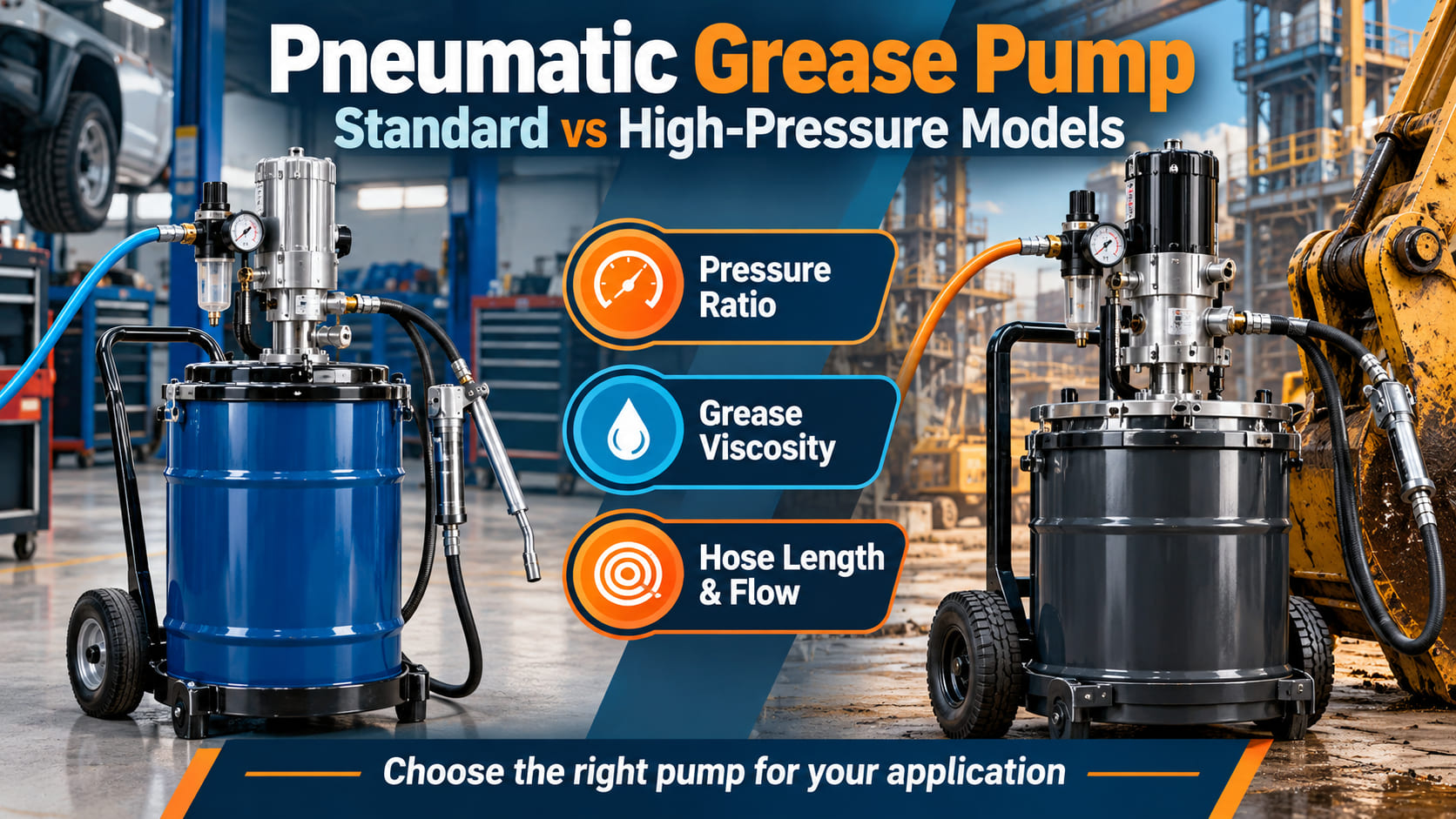
However, not every pneumatic grease pump is designed for the same task. Some models are built primarily for moderate-pressure workshop use, while others are engineered for high-pressure grease delivery through long hoses or centralized lubrication lines. This is why buyers should compare pressure ratio, output, grease viscosity capability, air consumption, drum compatibility, and working environment before making a decision.
Quick selection rule: if the application involves normal workshop lubrication and relatively short hoses, a standard pneumatic grease pump is often enough. If the system must overcome long delivery distances, high back pressure, multiple lubrication points, or very thick grease, a high-pressure model is usually the better choice.
Standard vs High-Pressure Pneumatic Grease Pump: Full Comparison
The most useful comparison for many buyers is between a standard pneumatic grease pump and a high-pressure pneumatic grease pump. Both use compressed air, but they are optimized for different operating conditions. The table below summarizes the practical differences.
| Item | Standard Pneumatic Grease Pump | High-Pressure Pneumatic Grease Pump | Best For |
|---|---|---|---|
| Primary Use | General lubrication and workshop maintenance | Heavy-duty and high-resistance lubrication systems | Depends on system resistance and workload |
| Pressure Capability | Moderate to high, depending on model | Designed for higher outlet pressure | High-pressure systems favor the second option |
| Grease Viscosity | Suitable for common workshop greases | Better for thicker grease and difficult pumping conditions | Choose based on grease grade and temperature |
| Hose Length | Best for short to medium delivery distances | Better for long hose runs | Long-distance delivery favors high pressure |
| Operating Frequency | Intermittent or routine servicing | Frequent or continuous industrial use | High-use facilities need more robust equipment |
| System Complexity | Simple grease gun or single-point setups | Multiple outlets or centralized lubrication | Complex systems usually need higher capability |
| Initial Cost | Generally lower | Generally higher | Budget-focused users may prefer standard models |
| Maintenance Demand | Usually straightforward | May require more attention in demanding applications | Depends on duty cycle and environment |
| Recommended User | Workshops, garages, general maintenance teams | Factories, mines, heavy machinery fleets, production facilities | Match the pump to workload, not just budget |
The main difference is not simply that one pump is “stronger.” A higher-pressure pump is designed to overcome greater resistance. That resistance may come from thick grease, cold operating temperatures, long hoses, narrow tubing, multiple distribution points, or restrictions inside bearings and lubrication blocks.
Buying a pump with far more pressure than the application requires does not automatically improve lubrication quality. It may increase equipment cost, air consumption, component stress, and maintenance requirements. Proper sizing is more important than choosing the largest available model.
How Does a Pneumatic Grease Pump Work?
A pneumatic grease pump uses compressed air to operate an air motor. The air motor moves a piston or plunger inside the pump body. As the piston reciprocates, grease is drawn from the container and forced into the outlet line under pressure.
1. Compressed Air Enters the Air Motor
Shop air or plant compressed air is supplied to the pump through an inlet. An air regulator is commonly used to control the incoming pressure. Proper air preparation can also help reduce moisture and contamination entering the air motor.
2. The Pump Mechanism Reciprocates
The air motor drives the pumping section repeatedly. This reciprocating action creates suction on one stroke and discharge pressure on the other. The relationship between air piston area and grease piston area determines the pump's pressure ratio.
3. Grease Is Forced Through the Delivery Line
Once pressurized, the grease travels through the outlet hose toward the grease gun, metering valve, bearing, manifold, or lubrication point. The longer and narrower the line, the more pressure may be needed to maintain practical flow.
4. The Pump Cycles According to Demand
Many pneumatic grease pumps operate only when grease is being discharged. When the downstream valve closes and pressure rises, the pump may stall until grease is requested again. This makes air-powered grease systems convenient for repetitive maintenance work.
Three Buying Scenarios: Which Pneumatic Grease Pump Is Right for You?
Scenario 1: First-Time Buyer or General Workshop
If you run an automotive repair shop, agricultural maintenance facility, small machinery workshop, or general service center, your lubrication jobs may involve wheel bearings, chassis points, joints, pins, bushings, and other routine grease fittings.
In this situation, a standard pneumatic grease pump is usually the most practical starting point. It provides faster and more consistent grease delivery than manual pumping without requiring the cost or complexity of a heavy industrial system. Look for a model with a compatible drum size, practical hose length, suitable pressure ratio, and readily available spare parts.
Scenario 2: Budget-Focused Buyer
If purchase cost is a major concern, avoid comparing pumps by price alone. A cheaper pneumatic grease pump may appear attractive initially, but the total cost of ownership can rise if seals wear quickly, replacement components are difficult to source, or the pump is undersized for the required grease viscosity.
A budget-conscious buyer should focus on the minimum specifications actually required by the application. There is little benefit in paying for extreme pressure capability if the pump only feeds a short grease hose in a workshop. At the same time, choosing an undersized pump for heavy grease or a long delivery line can lead to slow output and frequent maintenance.
Scenario 3: Efficiency-Focused Industrial User
Production plants, heavy-equipment fleets, mining sites, construction operations, and centralized lubrication systems often prioritize uptime and consistent grease delivery. In these environments, downtime caused by inadequate lubrication can be more expensive than the pump itself.
A high-pressure pneumatic grease pump is often a better match when grease must travel through long hoses, reach multiple lubrication points, or remain pumpable at lower temperatures. Buyers in this category should also examine continuous-duty suitability, serviceability, material durability, air consumption, filtration requirements, and compatibility with the entire lubrication system.
How to Choose a Pneumatic Grease Pump: 8 Key Factors
1. Pressure Ratio
Pressure ratio is one of the most important specifications. It indicates how the pump multiplies incoming air pressure into grease outlet pressure. A higher ratio can produce greater grease pressure, but the required ratio should be determined by actual system resistance rather than choosing the highest number available.
2. Grease Viscosity and NLGI Grade
Grease becomes more difficult to move as its consistency increases. Buyers should confirm the pump's compatibility with the grease normally used in the facility. Ambient temperature matters too, because grease can become significantly harder to pump in cold environments.
3. Required Flow Rate
A maintenance technician greasing a few machines does not need the same output as a high-volume fleet workshop. Compare pump output under realistic conditions rather than relying only on theoretical maximum figures.
4. Hose Length and Line Resistance
Long hoses create additional friction and pressure loss. Small-diameter lines, elbows, manifolds, metering devices, and restrictive fittings can further increase resistance. This is a major reason why some applications require high-pressure pumps.
5. Drum or Container Size
Pneumatic grease pumps may be configured for small pails, medium drums, or larger industrial containers. The pump tube length must match the intended container. High-volume users should also consider how often grease containers need to be replaced.
6. Air Supply Conditions
Check the plant or workshop air pressure, available air volume, air quality, and line size. Even a capable pneumatic grease pump may perform poorly if the compressed-air supply is unstable or insufficient.
7. Duty Cycle
Occasional maintenance is very different from daily industrial lubrication. High-frequency applications should prioritize durable seals, serviceable components, robust pump bodies, and a design suitable for repeated operation.
8. Spare Parts and Maintenance Support
Pumps contain wear components such as seals, packing sets, check valves, springs, and air motor components. Before purchasing, confirm whether rebuild kits and spare parts are readily available. Serviceability often matters more than a small difference in purchase price.
Pneumatic Grease Pump Cost: What Affects the Price?
Pneumatic grease pump prices can vary widely because the pump itself is only one part of the specification. Two pumps that look similar externally may differ substantially in pressure ratio, output, materials, seal design, air motor construction, accessories, and expected service life.
| Cost Factor | Why It Matters |
|---|---|
| Pressure Ratio | Higher-pressure designs generally require more robust components. |
| Pump Output | Higher delivery rates may require larger or more durable pumping mechanisms. |
| Materials | Industrial-grade components can improve durability in harsh environments. |
| Container Compatibility | Longer pump tubes, drum covers, follower plates, and mounting systems add cost. |
| Accessories | Hoses, grease guns, regulators, filters, reels, fittings, and carts affect package price. |
| Serviceability | Models with reliable spare-parts support may provide better long-term value. |
| Duty Rating | Heavy-duty industrial pumps are typically more expensive than intermittent-use workshop models. |
For this reason, a useful quotation should include more than the pump price. Ask whether the package includes a follower plate, drum cover, hose, grease control valve, air regulator, filter, mounting hardware, trolley, hose reel, and spare seal kit. Comparing complete configurations gives a much more realistic view of total investment.
Six Pneumatic Grease Pump Mistakes to Avoid
- Choosing only by maximum pressure: excessive pressure capability does not automatically make a pump more suitable.
- Ignoring grease consistency: a pump that works well with softer grease may struggle with high-consistency grease in cold conditions.
- Underestimating hose length: pressure loss increases as grease travels through longer or narrower lines.
- Forgetting the air supply: insufficient compressed-air volume can reduce pump performance.
- Buying without spare-parts support: unavailable seals or repair kits can turn a minor fault into lengthy downtime.
- Comparing pump price instead of total system cost: hoses, reels, regulators, follower plates, carts, and fittings may significantly affect the final budget.
A good purchasing process begins with the application. Record the grease type, container size, hose length, expected lubrication points, air pressure, working temperature, operating frequency, and desired output. Once these details are clear, comparing pneumatic grease pump models becomes much easier.
Pneumatic Grease Pump FAQ
Q1: What is the difference between a standard and high-pressure pneumatic grease pump?
A standard pneumatic grease pump is generally intended for routine lubrication with moderate system resistance, while a high-pressure model is designed to move grease through longer lines, restrictive fittings, centralized lubrication systems, or other applications where greater outlet pressure is required.
Q2: How much does a pneumatic grease pump cost?
The cost depends on pressure ratio, output capacity, materials, container size, accessories, duty rating, and brand or supplier support. Buyers should compare complete system configurations rather than the pump body alone.
Q3: How long does a pneumatic grease pump last?
Service life varies according to operating frequency, air quality, grease condition, working pressure, maintenance practices, environment, and component quality. Regular inspection and timely replacement of seals and wear parts can help extend service life.
Q4: Who should use a pneumatic grease pump?
Pneumatic grease pumps are suitable for workshops, factories, fleet maintenance facilities, agricultural equipment servicing, construction machinery maintenance, mining operations, and other environments that require frequent or efficient grease delivery.
Q5: What are the disadvantages of a pneumatic grease pump?
A pneumatic grease pump requires a compressed-air source and may consume significant air during frequent use. It also contains seals and moving parts that require maintenance. An improperly sized pump may deliver poor performance or create unnecessarily high system pressure.
Q6: Can a pneumatic grease pump handle high-viscosity grease?
Many pneumatic grease pumps can handle high-viscosity grease, but capability varies by model. Buyers should check the recommended grease consistency, operating temperature, pressure ratio, follower plate requirements, and inlet design before selecting a pump.
Q7: Does a longer hose require a larger pneumatic grease pump?
Not necessarily a physically larger pump, but longer hoses increase flow resistance and may require a pump with a higher pressure ratio or better delivery capability. Hose diameter, grease consistency, temperature, and fittings should also be considered.
Q8: What air pressure is required for a pneumatic grease pump?
Required air pressure varies by pump design. The correct operating range should always be taken from the manufacturer's specification. An air regulator is recommended so the pump is not operated above its rated inlet pressure.
Q9: Is a pneumatic grease pump better than a manual grease pump?
A pneumatic grease pump is usually more efficient for repetitive or high-volume lubrication because it reduces manual effort and provides more consistent delivery. A manual pump may still be suitable for occasional maintenance, portable jobs, or locations without compressed air.
Q10: What should I ask before buying a pneumatic grease pump?
Ask about pressure ratio, flow rate, recommended grease grade, air consumption, drum compatibility, maximum hose length, spare parts, seal kits, warranty, accessories, and service support. Providing your actual application conditions will help the supplier recommend a more suitable model.
社交媒體